Events
Young European Scientists Launch Initiative for a European Platform with Support from UEAA
11 02 2026
On 6 February 2026, a core group of young European scientists in agriculture, food, and environmental sciences held its inaugural online meeting. The event was organized by the Lithuanian Academy of Sciences and the Young Academy of the Lithuanian Academy of Sciences, with support from the Union of European Academies for Science Applied to Agriculture, Food and Nature (UEAA).
The meeting marked the first step toward establishing a European Platform of Young Scientists in agriculture in the broadest sense. The initiative aims to provide earlycareer researchers with a unified voice, strengthen scientific collaboration across Europe, and build long-term links with the UEAA. The platform is intended to be independent and driven by young scientists, while remaining strategically aligned with the UEAA to benefit from its experience and networks.
Vision and Mission
The proposed platform aims to support early-career researchers, foster international and interdisciplinary collaboration, strengthen their visibility and influence in European Union policymaking, and engage regions with lessdeveloped agricultural science infrastructure. Its scope will include agriculture, horticulture, forestry, veterinary sciences, food systems, nutrition, environmental and climate sciences, climate-resilient agriculture, the bioeconomy, and rural development. The scientific focus will remain flexible, be reviewed annually, align with EU research and policy priorities, and be responsive to evolving scientific and societal needs.
Initiating Core Group
Eighteen researchers from institutes across Europe – including Lithuania, Bulgaria, the Czech Republic, Georgia, Italy, Latvia, Moldova, Romania, Slovakia, Slovenia, and Sweden – participated in the meeting, representing a broad range of agricultural, food, and environmental science disciplines.

Dr. Paulina Štreimikytė.
At the start of the session, Paulina Štreimikytė from the Young Academy of the Lithuanian Academy of Sciences welcomed participants and highlighted the importance of active engagement and collaboration among early-career researchers. The opening discussion was moderated by Nazim S. Gruda, who clarified the meeting’s objectives and invited each participant to introduce their scientific background and research focus briefly.
Subsequent discussions explored the platform's main goals, long-term vision, strategic priorities, and opportunities for representation at the European level.
Prof. Gruda reflected on his long-standing idea to create a platform for a new generation of agricultural scientists, which he first presented at the UEAA General Assembly in Romania last year. He expressed his satisfaction at seeing the first formal meeting take place, emphasizing that the initiative addresses not only agriculture, but also the broader food and environmental sectors – areas that urgently require fresh ideas, engagement, and energy from emerging researchers. He encouraged participants to reflect on the platform’s core purpose and how it can support their growth as scientists and contributors to European research and policy.
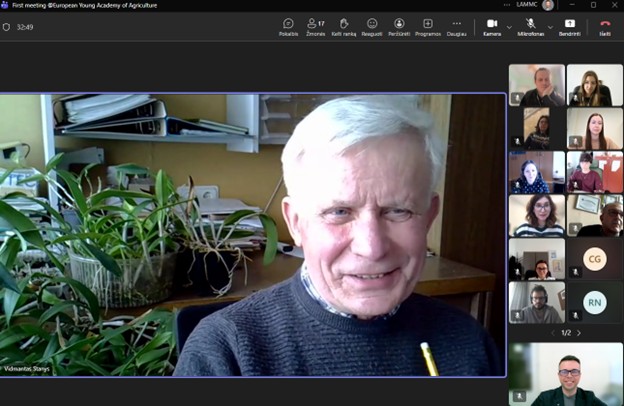
Prof. Vidmantas Stanys.
Prof. Vidmantas Stanys from the Lithuanian Academy of Sciences underlined that the initiative aims to become a vibrant European scientific community in which early-career researchers play an active role in shaping the future of agriculture, food systems, and rural development. He outlined two key priorities: fostering mutual learning within a supportive, open community and promoting the use of scientific evidence to address urgent challenges such as climate change, food security, and environmental sustainability.
Edvinas Misiukevičius from the Young Academy of the Lithuanian Academy of Sciences emphasized the importance of establishing a clear legal status, a transparent organizational structure, and strong interdisciplinary collaboration. Discussions also covered potential funding opportunities, project-based initiatives, thematic working groups, and ways to leverage existing academic networks.
Participants shared their perspectives and experiences. Marieta Nesheva from the Institute of Horticulture at the Bulgarian Agricultural Academy highlighted the value of networks such as EUFRIN in connecting horticultural research institutes. Carolyn Glynn from the Royal Swedish Academy of Agriculture and Forestry emphasized the contributions of early-career researchers and the need for institutional support. Karl Ljungstedt, also of Sweden, suggested beginning with a small core group to identify a priority funding program that could serve as a practical starting point, noting that initial international partnerships could be established at minimal cost using remote collaboration tools.
There was also consensus that future activities could be organized alongside major scientific events, such as the 15th International Conference of Young Scientists, “The Young Scientists for the Advancement of Agriculture” (AGRISCI2026), to be held in Vilnius on 26 November 2026. This would provide opportunities for in-person engagement and broader academic involvement.
Once feedback is collected from participants, the organizers plan to convene a follow-up meeting to review responses and explore further collaboration opportunities aligned with the group’s shared interests. The new organization will work closely with the UEAA, which will continue to support its development.
Prepared by: Edvinas Misiukevičius, Member of the Young Academy of the Lithuanian Academy of Sciences;
Edited by Nazim S. Gruda, Vice President of UEAA.


