Events
Workshop: Language(s) of Academia
21 09 2026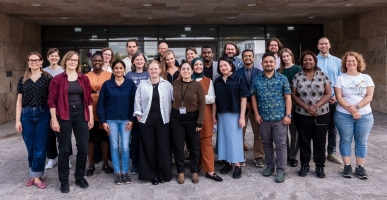
From 2 to 4 September 2026, 24 young academician working in 18 countries across six continents met at Goethe University Frankfurt am Main to discuss the role of language in the academic community. The meeting, initiated by Die Junge Akademie (the German Young Academy), was also attended by Ignas Kalpokas, a member of the Young Academy of the Lithuanian Academy of Sciences (Lietuvos mokslų akademijos Jaunoji akademija, LMAJA). The participants discussed how language affects academic research, its conduct, and the dissemination of results. Although the main language of the meeting was English, the academicians also brought their diverse linguistic and cultural experiences into the discussions. The meeting brought together representatives of the young academies of Belgium (Dutch), Colombia (Spanish), Finland (Finnish), Germany (German), Hungary (Hungarian), India (Assamese and Punjabi), Indonesia (Indonesian), Kenya (Kimeru), Lithuania (Lithuanian), Nepal (Nepali), Nigeria (Yoruba), Norway (Norwegian), Palestine (Arabic), Sudan (Arabic), and Switzerland (French and German), as well as of the Global Young Academy, whose representatives contributed their experience of Polish and Romanian.
Language is an integral part of academic’s everyday work, yet opportunities to reflect systematically on its influence on participation in academic life, access to science, the quality of research and its accessibility are relatively rare. The meeting provided an opportunity to examine these issues in greater depth, considering both the opportunities offered by language and the challenges associated with it.
The meeting was initiated by the members of the ‘Language’ working group of Die Junge Akademie The main focus was on language as one of the key elements of academic diversity, which in certain cases can also become a source of exclusion. The discussions examined how language affects science communication, professional career opportunities and working conditions, power relations within the academic community, the expression of national and regional interests, as well as the possible consequences of the rapidly expanding use of large language models.
An increasing share of academic activity is conducted in English. This offers a number of important advantages, and at the same time highlights certain difficulties. A common lingua franca facilitates international communication, the exchange of knowledge, and collaboration among researchers from different countries. On the other hand, excessive dependence on a single language can make participation in academic life more difficult and reduce the accessibility of research both to the wider public and to communities in which English is not the main language.
To move closer to a ‘glocal’ research model, in which scientific knowledge is shared globally while remaining accessible to local communities, language choice should be regarded as an integral part of research practice. This is relevant to academicians themselves, research institutions, and policymakers alike. At the end of the meeting, the participants agreed to continue discussions on the role of language within their institutions, academic disciplines, and the wider academic community.
Information of the Young Academy of the Lithuanian Academy of Sciences
Photo by the German Young Academy


