Events
Autumnal General Assembly of the Members of the Lithuanian Academy of Sciences
28 09 2026
The general assembly of the members of the Lithuanian Academy of Sciences (Lietuvos mokslų akademija, LMA) held on 22 September 2026 was attended by invited guests, among them Prof. Dr Inga Žalėnienė, president of the Lithuanian University Rectors' Conference, Academician Juozas Augutis, acting chair of the Research Council of Lithuania, Prof. Rytis Krušinskas, of the School of Economics and Business of Kaunas University of Technology, Prof. Egidijus Kūris of Vilnius University, patrons, and the staff of the LMA.
At the beginning of the event, Prof. Vytautas Nekrošius, president of the Academy, presented an update on the results achieved during the summer months after the general assembly in June. A team of public advisers to the president of the LMA was in the process of formation: Remigijus Lapinskas was appointed public adviser on environmental protection and energy security, Miša Jakobas on education policy, Rimantas Kraujalis on technological development, and Igor Lipsits on economic affairs. These advisers will help viewing the problems to be solved from a slight distance. The members of the LMA International Advisory Board were approved at a meeting of the LMA Presidium. Eleven renowned scientists from around the world, specialists in various fields, many of whom are foreign members of the LMA, were invited to join this board. The first virtual meeting took place on 21 September, during which the board elected its chair – Prof. Marek Konarzewski, president of the Polish Academy of Sciences.
The Lithuanian Academy of Sciences welcomed Her Excellency Shelly Hugler Livne, Ambassador Extraordinary and Plenipotentiary of the State of Israel to Lithuania, Dr Milda Ališauskienė, director of the Lithuanian Centre for Social Sciences, and Dr Tetiana Kalytenko, a Ukrainian scholar, as well as researchers from the Institute of Low Temperature and Structure Research of the Polish Academy of Sciences in Wrocław, who are carrying out a joint Lithuanian-Polish project.
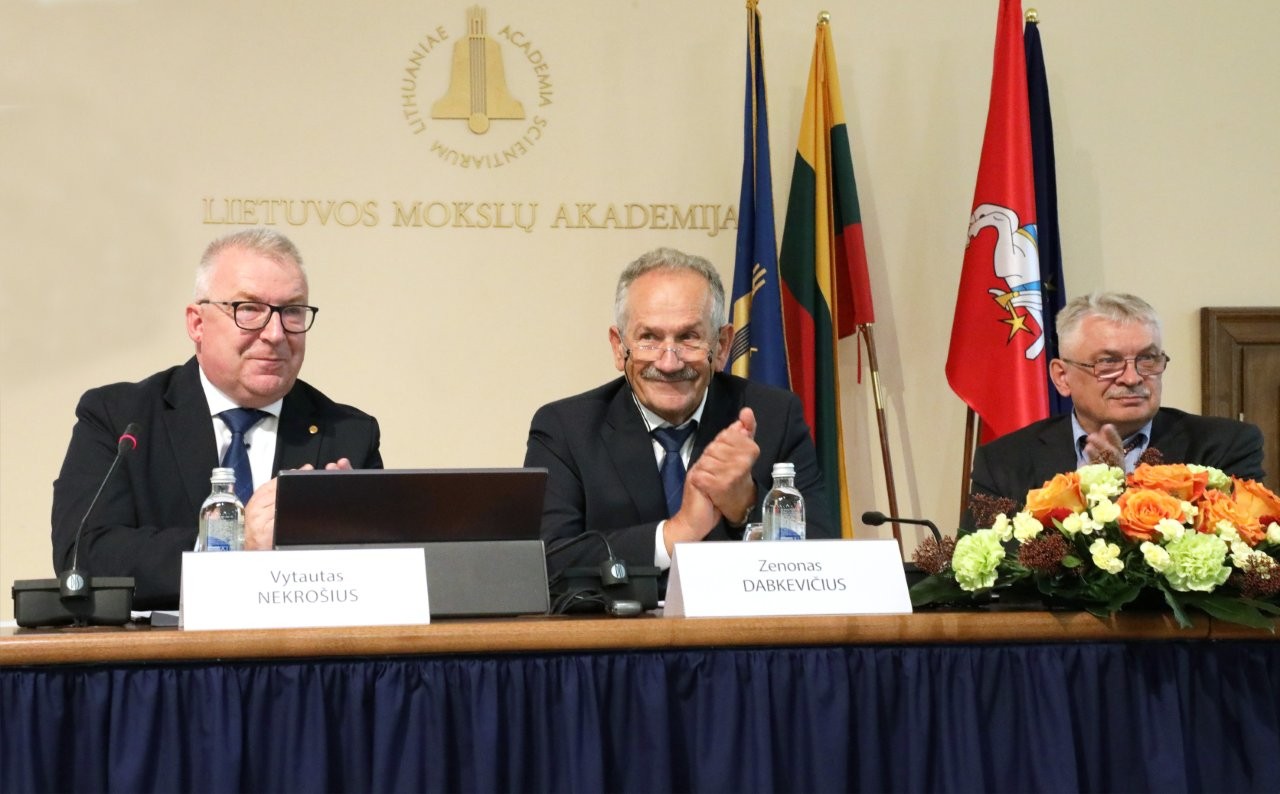
From left: Prof. Vytautas Nekrošius, President of the LMA; Academician Zenonas Dabkevičius, Chief Scientific Secretary (Chancellor); and Academician Aivaras Kareiva, Vice-President for Science and International Relations.
On 6 July, the Statehood Day, three members of the Lithuanian Academy of Sciences were awarded state decorations: Academician Vilmantė Borutaitė was awarded the Officer’s Cross of the Order of the Lithuanian Grand Duke Gediminas, the Knight's Cross of the Order of the Lithuanian Grand Duke Gediminas was awarded to Academician Rolandas Palekas, and Academician Remigijus Žaliūnas, was honoured with the Knight’s Cross of the Order ‘For Merits to Lithuania’. In June, Academician and Rector of Vilnius University Rimvydas Petrauskas was elected a foreign member of the Polish Academy of Arts and Sciences. Julius Vengelis, chair of the Young Academy of the Lithuanian Academy of Sciences, was admitted to the European Young Academy. The Coalition for Global Hepatitis Elimination awarded Academician Limas Kupčinskas the prestigious international 2026 Hepatitis Elimination Leader Award. On 11 September, at a ceremony at the residence of the Japanese Ambassador, Professor Virginijus Šikšnius of the Vilnius University Life Sciences Center was honoured with one of Japan’s most prestigious state decorations – the Order of the Rising Sun, Gold Rays with Neck Ribbon – for his outstanding contributions to promoting academic exchanges and strengthening mutual understanding between Japan and Lithuania. On 18 September, a joint jury meeting of the Baltic Assembly Awards convened in Riga and selected the winners of the 2026 prizes for literature, the arts and science. This year’s Baltic Assembly Prize for Science was awarded to Prof. Dr habil. Zenonas Norkus, a Lithuanian philosopher and sociologist, a full member of the Lithuanian Academy of Sciences. A cooperation agreement was also signed with the Lithuanian Bar Association.
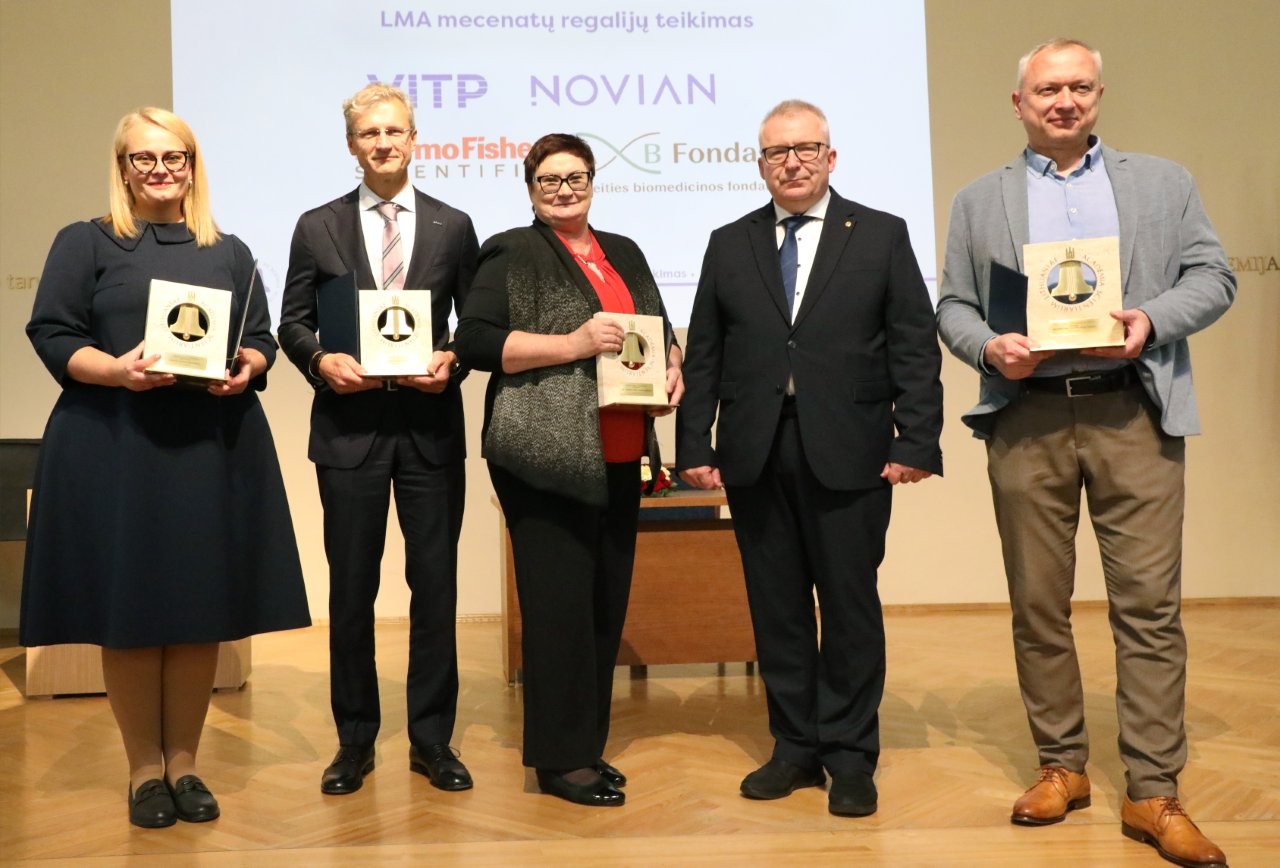
Prof. Vytautas Nekrošius with representatives of companies and organisations granted patron status by the LMA.
For the first time, the LMA announced its patrons. The President of the Lithuanian Academy of Sciences Prof. Vytautas Nekrošius emphasised that there had always been people who supported the Academy’s activities and events. It was finally decided to grant such individuals and organisations the status of patrons. By Resolution No. 37 of the Presidium of the Lithuanian Academy of Sciences dated 28 April 2026, the status of the first patrons of the LMA was granted to the Future Biomedicine Foundation, UAB Thermo Fisher Scientific Baltics, the Novian group of companies, and the public institution Visoriai Information Technology Park.
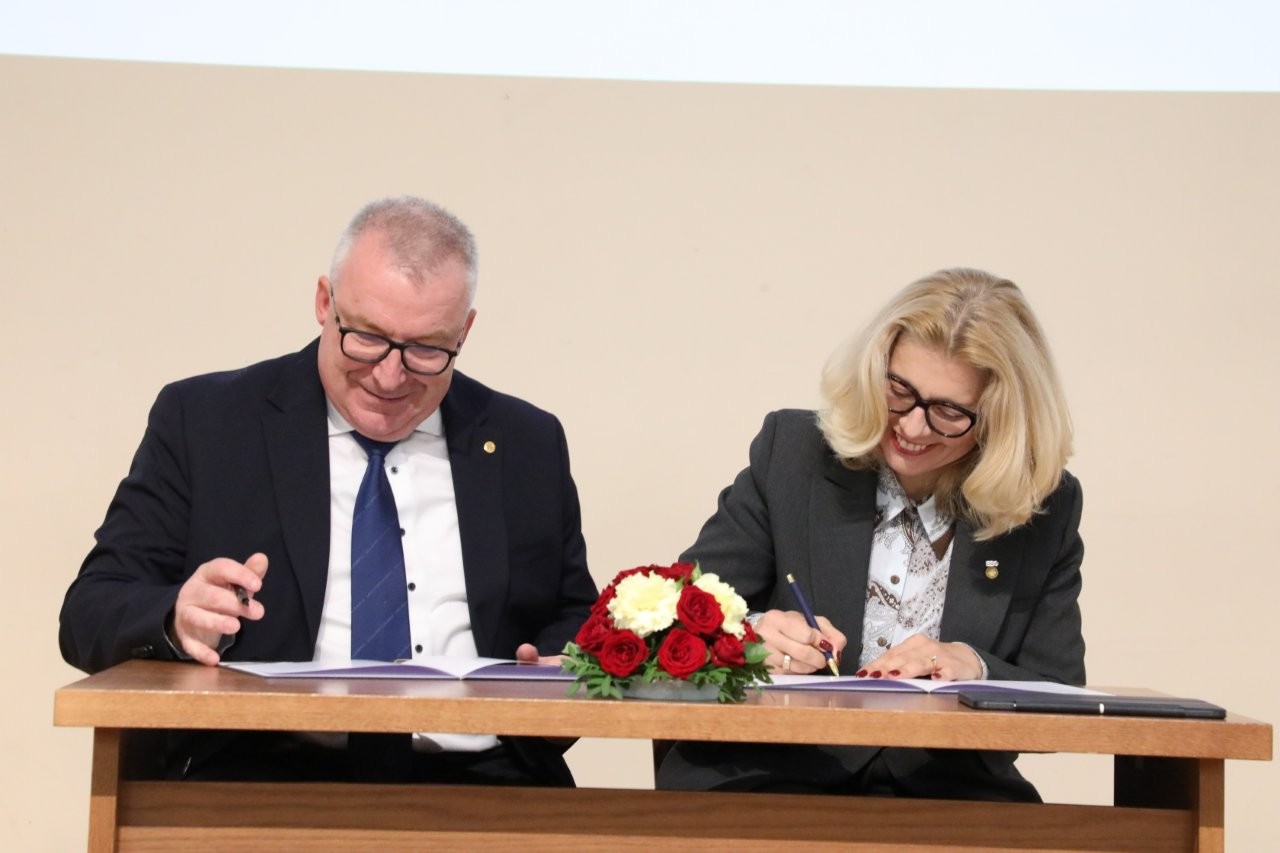
Prof. Vytautas Nekrošius and Prof. Dr Inga Žalėnienė sign the cooperation agreement between the LMA and the Lithuanian University Rectors’ Conference.
Next, a cooperation agreement was concluded between the Lithuanian Academy of Sciences and the Lithuanian University Rectors' Conference by Prof. Vytautas Nekrošius, president of the LMA, and Prof. Dr Inga Žalėnienė, president of the conference. Prof. Inga Žalėnienė said:
the Lithuanian University Rectors' Conference unites universities. The Lithuanian Academy of Sciences unites the most outstanding leaders in the country’s science. This represents tremendous intellectual potential. Together, we can be a powerful force – a genuine and reliable leader of opinion grounded in knowledge, capable not only of responding to change but also of driving it. I am confident that our agreement will strengthen the voice of the entire academic community on matters regarding the formulation of science and innovation policy and legislation and will promote joint research and innovation, the international visibility of Lithuanian science, science diplomacy, and meaningful dialogue with the wider public. I wish universities and the Academy to remain luminaries of society, its influencers.
The President of the Lithuanian Academy of Sciences emphasised that, to date, the Academy had not had any agreements with universities. Therefore the agreement between the Academy and the Lithuanian University Rectors' Conference is a starting point. The LMA is an umbrella organisation, and so is the Rectors’ Conference. This allows both institutions to effectively address Lithuania’s problems.
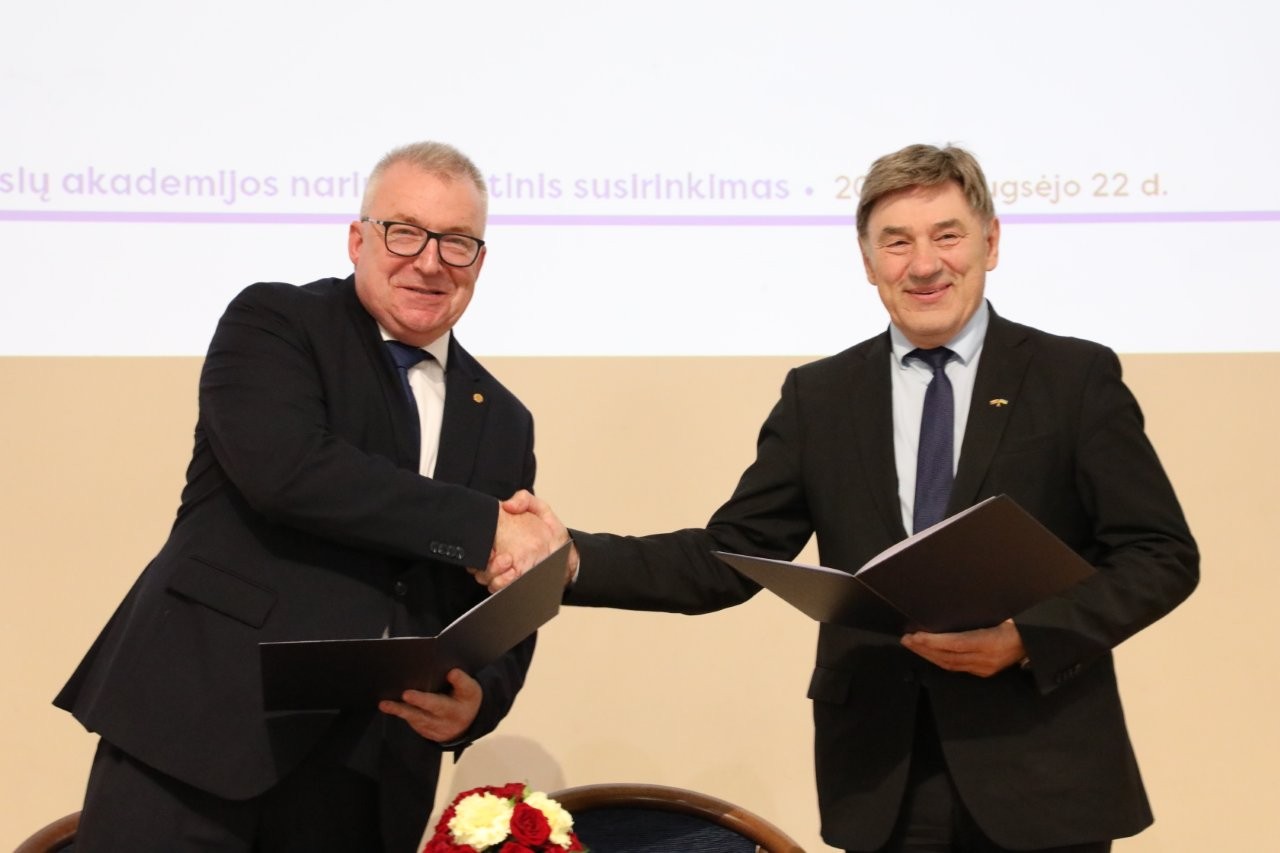
Prof. Vytautas Nekrošius and Academician Juozas Augutis shake hands after signing the memorandum of cooperation.
A further memorandum of cooperation was signed with the Research Council of Lithuania (Lietuvos mokslo taryba, LMT). It was signed by Prof. Nekrošius and Academician Juozas Augutis, the acting chair of the Research Council of Lithuania. ‘First and foremost, this memorandum is an expression of good will and our joint aspiration to consolidate cooperation. We are convinced that a closer partnership of our institutions will allow for mustering expert knowledge, for more constructive contribution to the formation of science policy, and, at the same time, for striving towards more ambitious and sustainable research funding in Lithuania’, said Academician Augutis. ‘So far, the LMA and the LMT have collaborated on various issues of importance to Lithuanian science. The memorandum provides a clearer long-term framework for this collaboration: it sets out common areas of activity, forms and principles of cooperation, and provides for regular dialogue between the institutions,’ spoke Prof. Nekrošius.
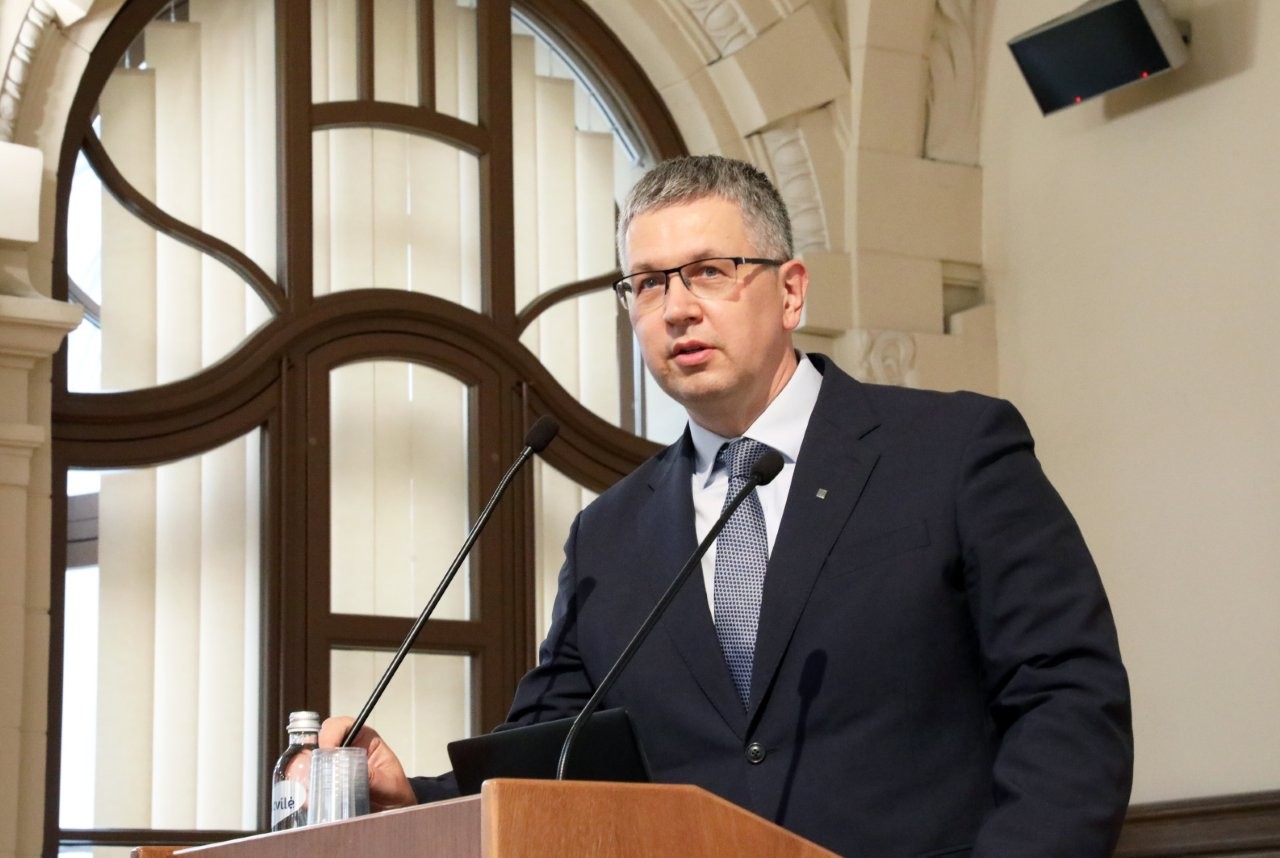
Prof. Rytis Krušinskas.
The second part of the meeting was devoted to two presentations reflecting the current state and future prospects of the social sciences in Lithuania. The first to speak was Prof. Rytis Krušinskas of the School of Economics and Business of Kaunas University of Technology. He spoke about ‘Challenges and Opportunities for Development of Economic Research’. He said that initially an agreement should be reached on what is meant by ‘economics’. In his view, it is the art of satisfying the demand for goods and services while making the most efficient use of resources. In essence, the fundamental questions in economic research are simple. Although much of it is self-evident, there are usually various disagreements and differing views. It all comes down to decisions and economic policy. One of the challenges facing economic research in recent times is the following: how does artificial intelligence model reality, and is the data used reliable? Furthermore, research is significantly influenced by the economic environment – recurring or overlapping ‘crises’ and our understanding of them. What aspects of the global research landscape can we adapt in Lithuania? It may sound unbelievable, but European economists often use data from US companies in their research. Also, the data used are often obsolete. For example, the article ‘Optimal Taxation of Robots’ uses data from the USA for 2005. What level are we ‘aiming’ for in Lithuania? Although the economic trends are similar, the sizes of the economies vary considerably. Therefore, economic models developed abroad are only partially suitable for our small economy. According to Prof. Krušinskas, possible solutions for Lithuania are the following: to research what we need and to work together to harmonise levels and standards. We need to realise that ‘less is more’ if we want to produce high-quality research articles. It follows, therefore, that we cannot put off the discussion on the future of economic science in Lithuania.
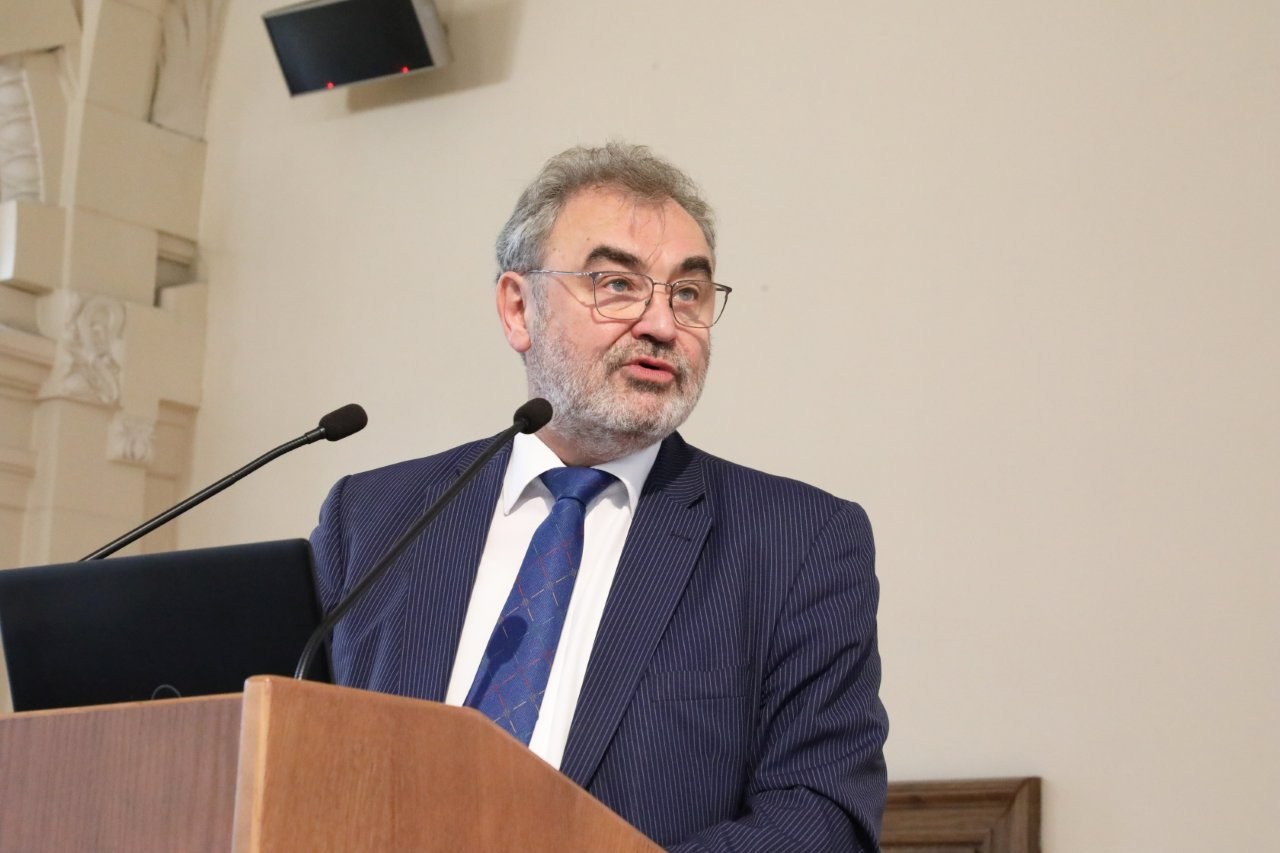
Prof. Egidijus Kūris.
The second speaker was Prof. Egidijus Kūris of Vilnius University, the former chair of the Constitutional Court of Lithuania. The title of his presentation was ‘The Letter and the Spirit of the Constitution’. He noted that the term ‘spirit’ had become a subject of ridicule in Lithuania, which is not the case in other countries. This meta-legal construct is not our invention. As early as the eighteenth century, a work with the title ‘The Spirit of the Law’ was published in France. Alexander Hamilton, one of the Founding Fathers of the United States of America, also wrote about the ‘spirit of the Constitution’. In the nineteenth century, a judge of the US Supreme Court spoke of the living spirit of the Constitution. Since the nineteenth century, this term has been used in the case law of the supreme courts of the USA and Canada. One might even call this spirit the ‘Invisible Constitution’ (which brings together principles such as the separation of powers, democracy, the preservation of human dignity, and the like), which imparts meaning to the text of a constitution. However, not everybody agrees with this. Some interpreters of the Constitution, known as textualists, insist that one should rely solely on the text. According to them, it is precisely formalism that turns governance into the rule of law rather than the rule of people. Interpretations give judges too much power. Both sides have their arguments, and it is understandable: if a text lacks meaning, the interpreter must imbue it with meaning. Little is explicitly stated in the Constitution of Lithuania, which is why it has to be constantly interpreted. Prof. Kūris concluded that political and legal culture is the most effective means of bridging the gap between the spirit and the letter of the Constitution.
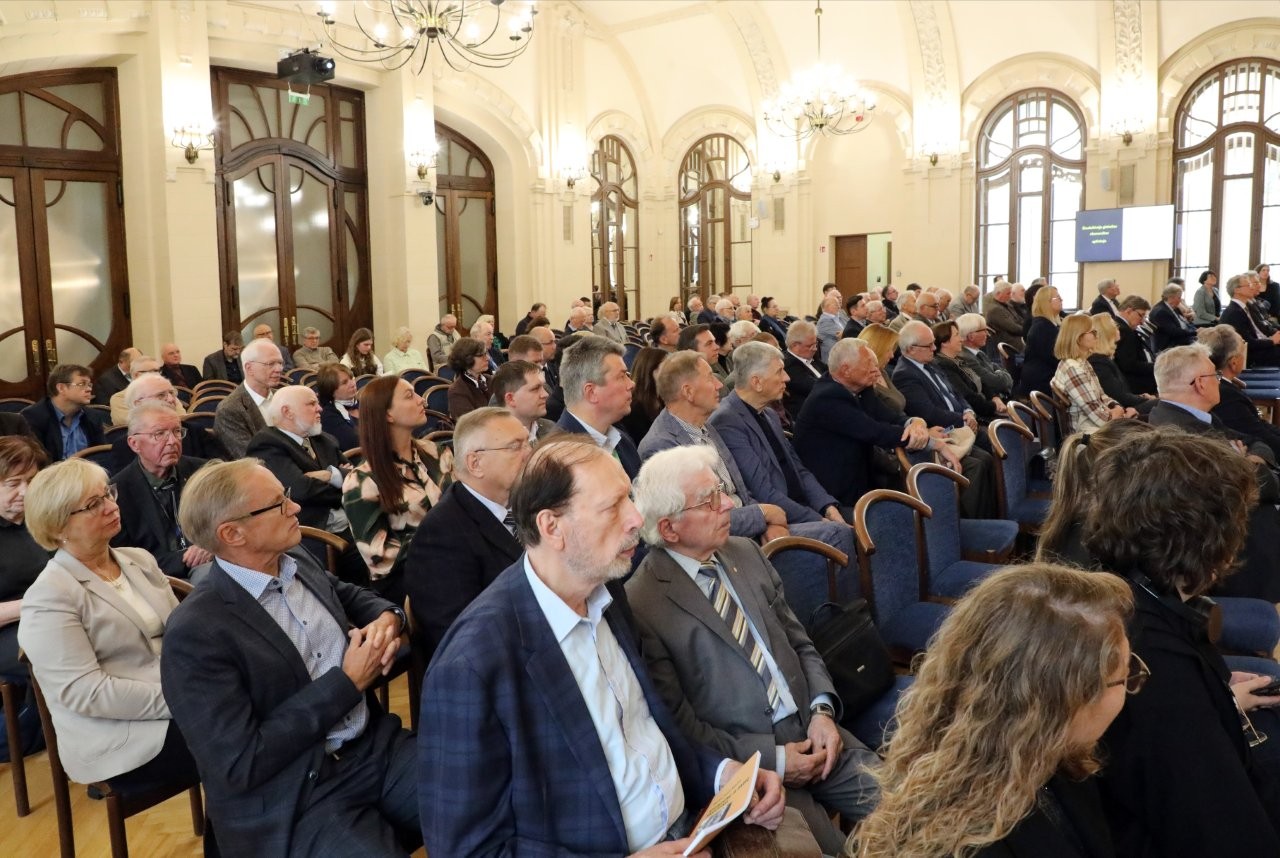
Participants of the event.
Dr Rolandas Maskoliūnas, chief specialist for public relations
Translated by Diana Barnard
Photos by Virginija Valuckienė


